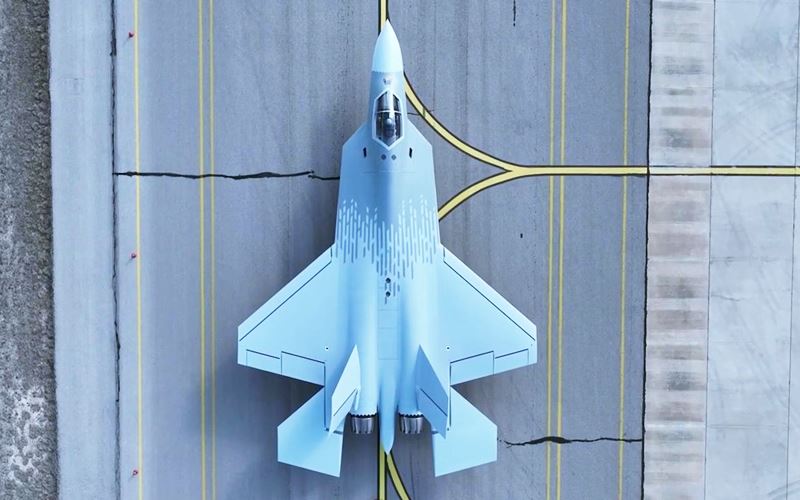
Turkish Aerospace Industries (TUSAŞ) has obtained an export license for the F110 engines that will power serial production of the KAAN national fighter, and its two HÜRJET prototypes are approaching a combined 500 flight hours, General Manager Mehmet Demiroğlu said at a press conference during the 2026 Farnborough International Airshow.
Demiroğlu took questions from reporters at the show and reviewed the status of the KAAN, HÜRJET, T-70 and T-925 programs. He said the F110 export process cleared the U.S. Congress stage on July 9, 2026, and that the required Technical Assistance Agreement (TAA) was secured afterward.
Engine hurdle overcome for KAAN
“We can say that we have obtained the export license for the engines,” Demiroğlu said, adding that TUSAŞ will work with GE Aerospace to align deliveries with KAAN’s production schedule. Ten F110 engines for prototype and flight tests are already in Ankara, and TUSAŞ is working to procure another 80 for the first production batch.
With KAAN mass production about two and a half years away, Demiroğlu said he does not expect any problem delivering the engines on time.
Two KAANs to fly together by year-end
On the flight-test schedule, Demiroğlu said the ground and system tests required before the P1 prototype’s maiden flight are under way and that the aircraft could fly within the next few months. Without naming a date, he said TUSAŞ aims to have the P2 prototype airborne by the end of 2026.
“Our goal is to see two KAANs flying side by side by the end of the year,” he said, confirming that the 2028 target for the first delivery to the Turkish Air Force still stands. Demiroğlu said the KAAN will be one of Türkiye’s main defense programs for the next 20 to 30 years, and recalled that a contract covering development and serial production was signed between TUSAŞ and the Presidency of Defense Industries at SAHA EXPO 2026.
Manned-unmanned teaming continues
Demiroğlu said the company is still developing its manned-unmanned teaming (MUM-T) concept, known in Turkish as Otonom Kol Uçuşu (OKU), or autonomous formation flight, and is not waiting for the KAAN to mature before doing so. The work uses the ANKA-3 and HÜRJET, along with smaller unmanned aircraft and swarm technologies.
Referring to a cooperation agreement signed with BAE Systems in 2025, Demiroğlu said one topic under discussion was pairing the ANKA-3 with fighters such as the Eurofighter Typhoon, though it has not yet become a formal program.
The T-70 program resumes
Demiroğlu said the T-70 general-purpose helicopter program has resumed after export-license and contract issues were resolved. Based on the Sikorsky S-70i platform, the program originally planned production of 109 T-70s for various public institutions.
TUSAŞ reached an agreement with Sikorsky in early 2026 for 39 more helicopters and has obtained the export license, Demiroğlu said. Of the fleet, 38 T-70s are complete; the new package raises the committed total to 77, and TUSAŞ plans to resume platform production in about 18 months.
Asked about CAATSA — the U.S. Countering America’s Adversaries Through Sanctions Act — Demiroğlu said the program’s end users (the Ministry of National Defense, the Turkish Air Force, the Land Forces and the General Command of the Gendarmerie) are not directly subject to the sanctions. He added that if Türkiye decides to proceed, the remaining 32 helicopters could also be built, bringing the total to 109.
The T-925 will cover the heavy-class requirement
Demiroğlu stressed that resuming the T-70 does not reduce the importance of the domestically developed T-925 heavy-class general-purpose helicopter. The T-70 buy is meant to cover near-term needs, he said, while the T-925 was developed for the large-scale platform modernization expected from the early 2030s.
Estimating that more than 200 helicopters in the Turkish Armed Forces’ inventory could be replaced between 2030 and 2040, Demiroğlu said that, counting both domestic and export opportunities, the T-925 has a production potential of roughly 400 to 500 units over the next 10 to 15 years, with export demand possibly reaching about 200.
HÜRJET approaches 500 flight hours
Demiroğlu said the two HÜRJET prototypes now in flight testing have logged about 500 flight hours combined, and that four more prototypes will join the program in 2026, including aircraft in the light-attack configuration.
Design work is continuing on a single-engine version for naval use, he said, with the Turkish Navy as the primary potential customer and interest from other countries as well. Demiroğlu said TUSAŞ would pursue every suitable international program, including opportunities in the United Kingdom, and that alternative engines such as GE Aerospace’s F404 and F414 are under evaluation for future variants.
NATO, the F-35 and civil aviation
Demiroğlu said NATO’s agenda centers on higher defense spending, stronger industrial capacity and better interoperability among allied systems. He said he expects Türkiye’s defense industry to be used more widely by allied countries, though issues such as export licenses and restrictions still need to be resolved.
On the F-35, Demiroğlu said the decision to buy the aircraft rests with the government, while industrial participation is a separate question. “Once these obstacles are removed, we see no reason why we shouldn’t return to the program,” he said, adding that any return would not change the strategic importance of the KAAN.
Demiroğlu said TUSAŞ continues to supply structural components to Airbus, Boeing, Leonardo and Sikorsky and aims to expand its civil-aviation structural work.