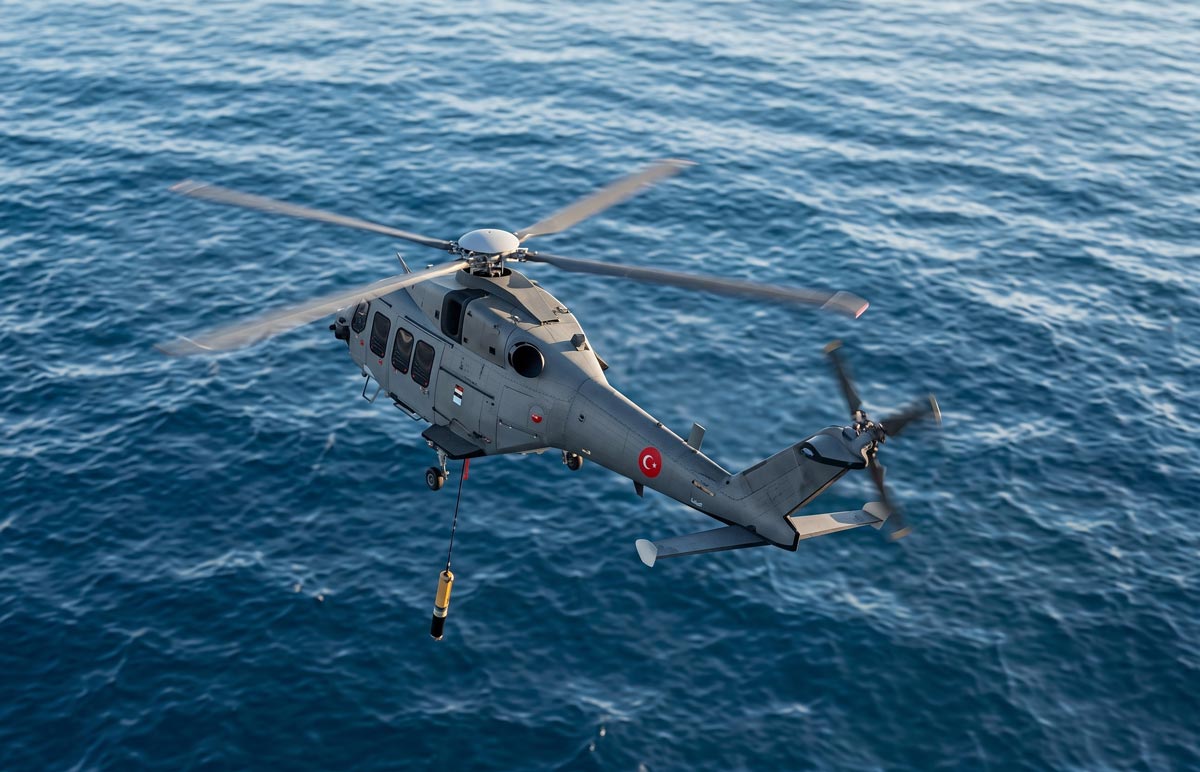
Turkish defense firms ARMELSAN and Turkish Aerospace Industries (TUSAŞ) signed a memorandum of understanding at the SAHA 2026 defense fair to integrate the ORKUN-2053 towed sonar system into the GÖKBEY helicopter, aiming to enhance Turkey’s anti-submarine warfare (ASW) capabilities and expand operational flexibility through domestically developed systems.
The agreement, attended by senior executives from both companies, marks a step toward equipping the T625 GÖKBEY with advanced underwater detection capabilities. TUSAŞ said the integration would elevate the platform’s multi-role mission profile, while ARMELSAN described the ORKUN-2053 as “the new and sharp eye of anti-submarine warfare.”

According to company statements, the ORKUN-2053 differs from conventional ship-based sonar systems by offering improved detection performance in deep-water environments. Its high output power and advanced signal processing algorithms allow it to overcome acoustic layering effects in seawater, enabling detection at depths typically beyond the reach of hull-mounted systems.
Helicopter-deployed towed sonar systems operate by lowering a sonar transducer into the water via cable while the aircraft hovers near the surface. This approach enables both active and passive detection, supporting low-noise listening operations as well as active search missions in contested maritime environments.
Technical specifications indicate the ORKUN-2053 operates in the 3–5 kHz frequency range and can reach operational depths of up to 350 meters. Weighing less than 270 kilograms, the system is designed for integration into medium-class helicopters such as GÖKBEY.
The global market for helicopter-deployed sonar systems is currently dominated by platforms such as the U.S.-made AQS-22 ALFS and HELRAS, as well as France’s FLASH system. Analysts note that the development of a domestic alternative could reduce Turkey’s reliance on foreign technologies in critical ASW domains, particularly through sovereign control over software and acoustic data libraries.
Defense experts say integrating towed sonar into the GÖKBEY platform could strengthen Turkey’s air-sea operational integration, enhancing submarine detection and engagement capabilities in deep waters. The move is seen as strategically aligned with Ankara’s “Blue Homeland” maritime doctrine, which emphasizes deterrence and situational awareness across its maritime jurisdiction areas.
While an official naval variant of the T625 GÖKBEY has not yet been formally announced, the sonar integration effort is viewed as a key milestone in adapting the helicopter for maritime operations. Industry observers say the development signals a transition from a general-purpose utility platform to a potential multi-role naval asset.
However, experts caution that full navalization will require additional modifications beyond sonar integration. These include foldable rotor and tail structures for shipboard storage, corrosion protection systems for saltwater environments, and automated takeoff and landing capabilities for operations on confined decks.
Further capability enhancements would likely involve the integration of maritime search radar, electro-optical systems, sonobuoys, and magnetic anomaly detectors, alongside lightweight torpedoes and other maritime munitions to provide both detection and engagement capabilities.