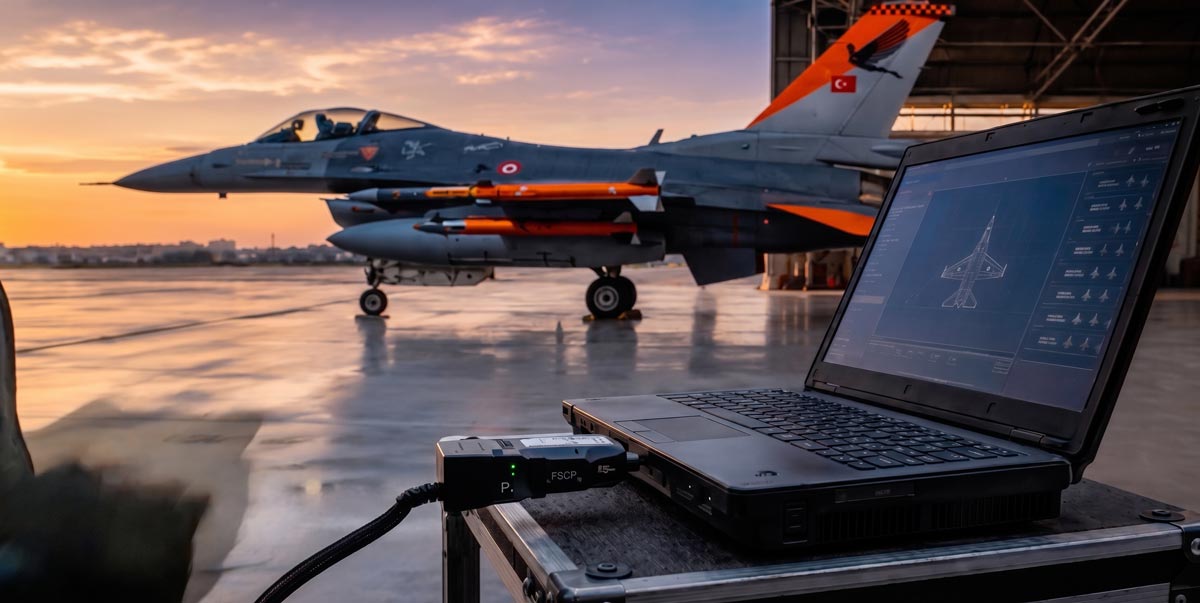
HAVELSAN’s Fleet-Level Mission Planning Software (FSGP) has successfully passed its final acceptance process under the ÖZGÜR Project, a flagship initiative modernizing the Turkish Air Force’s F-16 fleet with domestically developed avionics. The completion of this milestone ensures that the operational planning infrastructure for F-16s equipped with national mission computers is now fully independent and sovereign.
FSGP development originally began in 2003, and the system has been in active service with the Turkish Air Force since 2007. It supports comprehensive mission planning and post-flight analysis across a wide range of aerial platforms, including combat jets, training aircraft, cargo transports, and the Barış Kartalı Airborne Early Warning and Control (AEW&C) aircraft.
The software consolidates a robust suite of capabilities under a single infrastructure:
- Geographic Information System (GIS) support
- Route and navigation planning
- Flight performance calculations
- Critical altitude analyses (Minimum En Route Altitude [MEA], Minimum Safe Altitude [MSA], and Emergency Safe Altitude [ESA])
- Threat, risk, and radar coverage assessments
- Munitions attack planning and post-mission debriefing analysis
FSGP’s Role in the ÖZGÜR Project
The overarching goal of the ÖZGÜR Project is to eliminate reliance on foreign OEMs (Original Equipment Manufacturers) by integrating domestic avionics and software into the F-16 fleet. HAVELSAN’s mission planning software serves as the digital backbone for this transition.
Through this project, a new generation of domestic smart munitions and weapon systems has been fully integrated into the FSGP, including:
- SOM (Stand-Off Missile)
- HGK (Precision Guidance Kit)
- KGK (Winged Guidance Kit)
- TOLUN (Miniature Glide Bomb)
- TEBER (Laser/GPS Guidance Kit)
This deep integration allows the Turkish Air Force to freely program, deploy, and load these indigenous munitions onto modernized F-16s, entirely insulated from foreign embargoes or supply-chain restrictions.
Technical Infrastructure and Operational Flexibility
The FSGP features a dual-mode operational architecture designed for high-intensity conflict environments:
- Networked Mode: Connected directly to the Air Force Information System (HvBS — Hava Kuvvetleri Bilgi Sistemi), the software automatically retrieves Air Mission Orders (AMOs), airspace restrictions, real-time meteorological data, NOTAMs (Notices to Airmen), and intelligence updates. While core integration is established, optimization updates continue in parallel with new ÖZGÜR capability rollouts.
- Standalone Mode: The system can operate entirely offline without a network connection, ensuring mission continuity in degraded or electronically contested environments.
Additional technical features include native support for global navigation databases (such as DAFIF and Jeppesen) and an advanced 2D/3D map infrastructure for terrain avoidance and threat analysis.
Comparison With Allied Systems
Functionally, the FSGP is Türkiye’s equivalent to the Western Joint Mission Planning System (JMPS)—a cooperative program used by the U.S. Air Force and Navy developed by contractors like Leidos, BAE Systems, and Lockheed Martin. Just as JMPS allows Western pilots to write mission data to a Data Transfer Cartridge (DTC) to upload into the jet, FSGP executes this exact workflow for Turkish F-16s using entirely national source code.
Compared to similar European solutions, such as the Mission Planning System (MPS) by Italy’s Leonardo, the FSGP’s distinct edge lies in its native, unrestricted access to Turkish-made weapons. Full compatibility with assets like the SOM missile and TOLUN bomb gives FSGP an operational flexibility in the Turkish theater that no Western counterpart can match.
Expansion to Next-Generation Platforms
The utility of the FSGP extends far beyond legacy fighters. The software has been selected as the baseline planning infrastructure for Türkiye’s newest aviation programs, including the HÜRKUŞ (basic trainer), HÜRJET (advanced jet trainer/light attack aircraft), and the KAAN National Combat Aircraft (MMU). This positions FSGP as the unified operational planning standard across the country’s entire aerospace ecosystem.
Strategic Significance
The final acceptance of the FSGP under the ÖZGÜR Project marks a definitive milestone in Türkiye’s digital sovereignty. By securing a self-sufficient planning infrastructure capable of seamlessly adopting domestic weapon systems, the Turkish Air Force has neutralized a critical geopolitical bottleneck, anchoring its long-term defense autonomy.