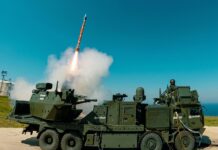
Unmanned systems developed by Baykar and ASELSAN using national capabilities have successfully completed a critical live-fire test in the Mediterranean, demonstrating a new level of joint operational capability for the Turkish Navy.
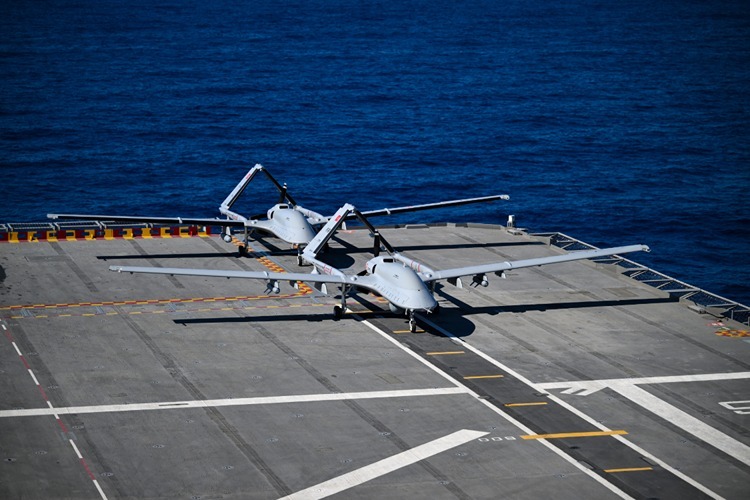
During the exercise, a Bayraktar TB3 unmanned aerial vehicle (UAV) launched from the amphibious assault ship TCG Anadolu guided an ASELSAN Albatros-S kamikaze unmanned surface vehicle (USV) to a maritime target via a data link. The test was observed on site by military delegations from Italy, the United Kingdom, Spain, Japan, and Brazil, highlighting international interest in the capability.
Live-Fire Mission off Antalya
As part of the mission conducted off the coast of Antalya, two Bayraktar TB3 UAVs took off sequentially from TCG Anadolu and reached the designated operational area.
One TB3 engaged land targets on a designated island using MAM-T and MAM-L precision-guided munitions produced by ROKETSAN. The second TB3 neutralized a separate target using KEMANKEŞ-1, an artificial intelligence-supported mini cruise missile developed by Baykar.
Following the strikes, both UAVs completed their recovery profiles. One TB3 landed on TCG Anadolu, took off again, and returned to Keşan, while the second landed directly in Keşan, in line with the mission plan.
First Operational Demonstration of a Distributed Strike Chain
Defense analysts describe the test as the first concrete operational demonstration of a distributed unmanned strike chain in Turkish naval doctrine. The TB3’s real-time guidance of the Albatros-S via data link reflects an emerging “distributed lethality” approach, in which multiple unmanned platforms operate as a coordinated network rather than as standalone assets.
The use of MAM-T, MAM-L, and KEMANKEŞ-1 also underscored the TB3’s ability to conduct multi-layered engagements, ranging from short- and medium-range precision strikes to longer-range cruise missile attacks.
The Albatros-S USV, designed for kamikaze-style missions, adds a low-cost saturation attack option against surface combatants, coastal installations, and radar sites.
TCG Anadolu Recast as an Unmanned Operations Hub
The test further highlighted the transformation of TCG Anadolu from a traditional amphibious ship into an unmanned operations base. The vessel is now positioned as a multi-role command platform capable of deploying TB3 UAVs, controlling USV swarms, and supporting mini cruise missile operations.
This shift reflects Turkey’s broader post–F-35B strategy, which emphasizes unmanned systems as a cost-effective alternative to fixed-wing carrier aviation. Analysts note that the concept may appeal to medium-sized navies unable to afford billion-dollar aircraft carriers.
Toward a Mobile Maritime A2/AD Envelope
Combined with shore-based anti-access/area denial (A2/AD) assets, the TB3’s persistent airborne presence, KEMANKEŞ-1’s reported 200-kilometer-plus engagement range, and the swarm potential of KİDA platforms effectively create a mobile maritime A2/AD shell.
The test demonstrated the feasibility of several operational concepts, including:
- UAV-designated targeting followed by USV strikes
- Simultaneous TB3 and KEMANKEŞ attacks
- Saturation attacks using USV swarms followed by precision UAV strikes
- Integrated command from TCG Anadolu alongside land-based UAV elements
Defense experts characterize this architecture as a highly maneuverable, unmanned-heavy “kill web”, marking a shift away from platform-centric naval warfare.
Strategic and Export Implications
According to analysts, the successful demonstration places Turkey among a small group of countries capable of executing network-centric unmanned naval warfare concepts comparable to those under development in the United States and China—but with proven operational execution.
The presence of foreign military observers has also fueled expectations that the TB3–Albatros-S–KEMANKEŞ combination could be marketed internationally as a ready-made naval warfare package, potentially opening a new chapter in Turkey’s defense exports.
Asymmetric Pressure on High-End Navies
The doctrine rests on three strategic pillars:
- Swarm saturation capability, able to stress even advanced air- and missile-defense systems
- Operational flexibility, enabled by ship-based launch and independent recovery to land bases
- Cost asymmetry, in which relatively low-cost unmanned systems pose credible threats to frigates, destroyers, and other high-value surface combatants
Analysts say the concept signals a broader trend in naval warfare, where numerical mass and networking increasingly challenge platform quality.