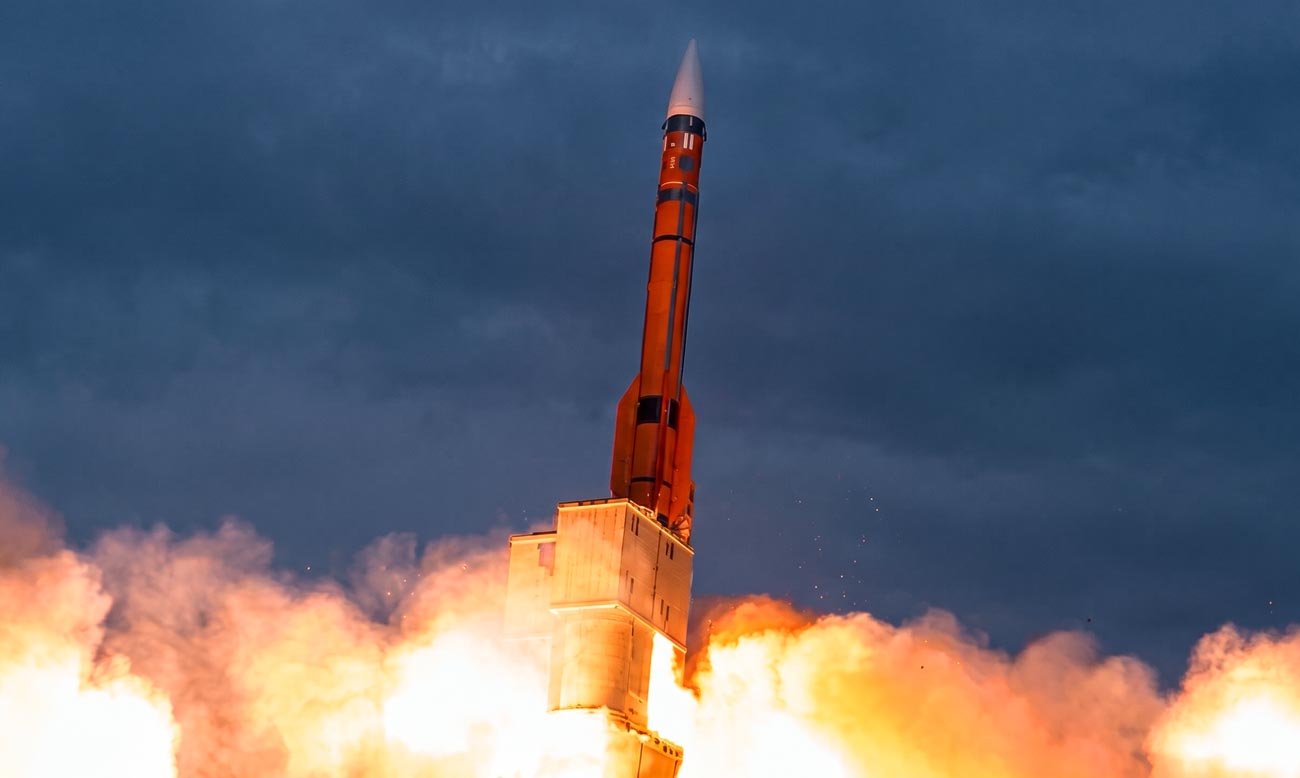
Türkiye’s SİPER Product-2 long-range air and missile defense missile was redirected to a new target after launch and destroyed it during a firing test in Sinop, ROKETSAN, ASELSAN and the Presidency of Defense Industries (SSB) said on Sunday. It was the first time the system had demonstrated in-flight retargeting in the field.
The test was conducted against targets flying close to the sea, ASELSAN said. It evaluated engagement of the first target, retargeting of the missile to a second target after launch, and the system’s mid-course and terminal guidance.
“We continue to acquire critical capabilities that will enhance the effectiveness of our national air and missile defense,” SSB President Haluk Görgün said. He said the system strengthens the long-range layer of Steel Dome, Türkiye’s layered air defense architecture, and improves its ability to respond to evolving threats.
“With the advanced capabilities we have developed to counter evolving threat scenarios, we are strengthening the effectiveness of our Steel Dome and increasing operational flexibility in our air defense,” ROKETSAN said in its statement.
Target updates over a two-way data link
Retargeting relies on a two-way radio frequency (RF) data link between the missile and its fire control radar. During the mid-course phase the missile receives updated commands over that link. In the terminal phase it locks on to the target with its own active RF seeker.
The capability lets a battery send a missile already in flight after a higher-priority threat instead of firing a second round, which conserves interceptor stocks and shortens engagement time. Targets flying close to the sea fit a low-altitude threat profile that radars detect late because of the radar horizon.
SİPER Product-2 test history
The SSB signed the SİPER contract with the ASELSAN-ROKETSAN-TÜBİTAK SAGE consortium on Jan. 15, 2018. ROKETSAN and TÜBİTAK SAGE, the defense research institute of the Scientific and Technological Research Council of Türkiye, are responsible for missile development. ASELSAN is in charge of the radars, command and control, and electronic systems.
Product-2 was first fired in August 2023 at the Sinop Test Center, where telemetry was collected under flight conditions. A test on Sept. 12, 2024, exercised the Fire Control Center, data link and Missile Launch System together with the missile. In a firing on June 12 this year, the missile destroyed a maneuvering aerial target.
Product-1, the system’s first variant, entered the Air Force Command’s inventory in 2024.
Single-stage missile and battery architecture
Product-2 shares its radar, command and control, launch and communication components with Product-1. Product-1 was developed as a two-stage missile by adding a booster to the HİSAR-O RF design. Product-2 instead uses a single-stage (monoblock) rocket motor 420 millimeters in diameter, so there is no spent booster to fall back to the ground after launch.
- Battery: engages 10 targets simultaneously and guides 20 missiles
- Search radar: ALP 310-G, active electronically scanned array (AESA) design with 360-degree coverage through digital beamforming, according to ASELSAN
- Fire control radar: PUSAT 1000-G on a 6×6 tactical vehicle, tracking multiple targets while keeping data links with the missiles
- Fleet Control Center: manages up to eight batteries
- Fire Control Center: manages up to eight missile launch systems
- Launcher: six missiles per vehicle
- Networking: connects to higher command networks via RADNET, Link 16 and JREAP-C (Joint Range Extension Applications Protocol C)
About 1,000 subcontractors are involved in the project, Görgün said.
In range and target set, Product-2 falls in the same class as the PAC-2 GEM-T, Aster 30 and Barak ER. Its architecture, with active RF guidance and vertical launch, is closer to the Aster 30 and Barak ER. Both of those systems can also intercept tactical ballistic missiles, a role Product-2 does not cover.
Ballistic missile defense layer
Türkiye is assigning the ballistic missile defense mission to newer members of the SİPER family. Block-3, with a targeted range of more than 180 kilometers, is in development. In May, Görgün announced the SİPER-A interceptor, designed to destroy its target by direct impact (hit-to-kill) in the terminal phase.
The planned Block-4 is aimed at the class of the U.S. Terminal High Altitude Area Defense (THAAD) system and Standard Missile-3 (SM-3), with an infrared seeker, multistage propulsion and an exoatmospheric intercept profile. It is expected to operate alongside the ALP 500-G and ALP 600-G early warning radars.
From fixed engagement plans to dynamic interception
In-flight retargeting moves SİPER from fixed engagement plans toward a network-centric, dynamic interception model, giving each battery more capacity against saturation attacks and low-altitude threats. Once Product-2 enters service, the long-range layer of Steel Dome will have a domestically developed option in a category where Türkiye has relied on foreign systems.