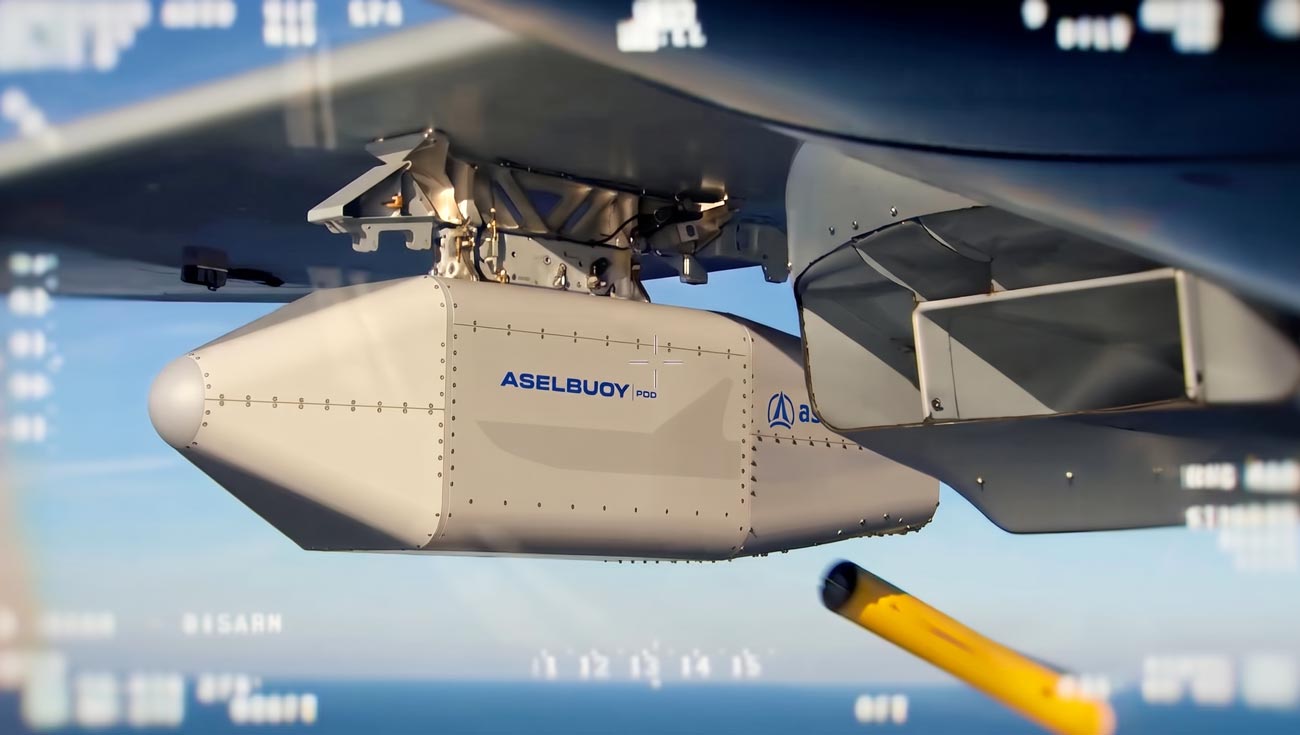
A TUSAŞ-built AKSUNGUR unmanned aerial vehicle has dropped ASELSAN’s aselBUOY 100P sonobuoys off the coast of Antalya, the first time the Turkish-made sonobuoy has been deployed from an unmanned aircraft, Turkish Aerospace Industries (TUSAŞ) said.
The drop took place during the Turkish Naval Forces’ TURNAs-26 Unmanned Maritime Systems Exercise. The AKSUNGUR carried three aselBUOY 100P units and one other sonobuoy, according to a TUSAŞ statement released on Saturday. Acoustic data from the buoys was relayed by satellite to Ankara, where it was processed to identify underwater targets.
“With this integration, which provides a significant capability for collecting underwater acoustic data and supporting submarine warfare missions, the AKSUNGUR takes its versatile mission capabilities in naval operations one step further,” TUSAŞ said.
AKSUNGUR mission profile off Antalya
The AKSUNGUR took off from Ankara and reached the mission area under beyond-line-of-sight (BLOS) satellite control. Off Antalya it descended to 1,000 feet and released the buoys from the aselBUOY POD, a modular launcher ASELSAN developed for unmanned aircraft.
It then climbed to 6,000 feet for the signal monitoring and data relay phase. Powered by domestically produced PD170 engines from TUSAŞ Engine Industries (TEI), the aircraft stayed over the area for about four hours, passing aselBUOY data to the integrated acoustic data transmission center at its ground control station in Ankara.
aselBUOY 100P passive sonobuoy
The aselBUOY 100P is a NATO Size A passive directional sonobuoy designed for anti-submarine warfare (ASW), search and rescue, and underwater acoustic research. It listens without emitting active sonar pulses, so it gives away the position of neither the target submarine nor the hunting platform.
- Frequency band: 5–2,400 Hz
- Operating depth: 30 or 150 meters
- Data link: one of 96 VHF channels, range up to 20 kilometers
- Self-destructs at the end of its programmed operating life
ASELSAN started the project with its own funds in late 2015 and carried out the first air-launch tests in 2018 from a launcher mounted on a Cessna-type turboprop. In February, ASELSAN General Manager Ahmet Akyol said the system had entered mass production at the start of the year, after the first production contract was signed with the Turkish Naval Forces Command. He said at the time that live drop tests from a UAV would follow within weeks.
Sonobuoy drops from unmanned aircraft elsewhere
Unmanned aircraft have dropped sonobuoys before. U.S.-based General Atomics Aeronautical Systems (GA-ASI) released a sonobuoy from an MQ-9 on Nov. 24, 2020, which the company described as the first deployment from a fixed-wing UAV. GA-ASI had first shown it could remotely process sonobuoy data with the MQ-9A in 2017.
Working with the U.S. Naval Air Systems Command (NAVAIR), GA-ASI dropped 10 sonobuoys from an MQ-9B SeaGuardian over the W-291 test range in California on Feb. 27, 2024. In a January 2025 test, the SeaGuardian used sonobuoy pods to detect and track underwater targets. In January 2026, the company announced that Multistatic Active Coherent (MAC) sonobuoys had been dispensed from an unmanned aircraft for the first time.
MAC was developed for the U.S. Navy’s P-3C and P-8A Poseidon maritime patrol aircraft. It has three parts: the AN/SSQ-125 source sonobuoy, the AN/SSQ-101 receiver sonobuoy and onboard processing software. On command, the source buoy emits acoustic pulses in several waveforms, including low-frequency coherent tones that carry over long distances. Receivers spread across the area pick up echoes from a submarine at different angles, which makes it harder for a boat to escape detection by keeping a narrow aspect toward any single sonar.
MAC replaced the older Improved Extended Echo Ranging (IEER) system, which was non-coherent and used small explosive charges as its sound source. Coherent pulses make the system sensitive to target speed through the Doppler effect and suppress clutter from echoes off the seabed. Compared with Directional Frequency Analysis and Recording (DIFAR) and Directional Command Activated Sonobuoy System (DICASS) buoys, MAC can search a wider area with fewer buoys.
China unveiled the Wing Loong X at the Dubai Airshow in November 2025. Beijing says the UAV can drop sonobuoys, analyze acoustic data with artificial intelligence and carry lightweight anti-submarine torpedoes, but no live test of those capabilities has been made public.
Naval News has reported that the AKSUNGUR would become the second operational UAV able to deploy sonobuoys if TUSAŞ met its target. That timeline slipped, but the AKSUNGUR is now one of a small number of platforms to have publicly demonstrated the capability.
Unmanned anti-submarine warfare: endurance and cost
ASW missions have traditionally been flown by maritime patrol aircraft (MPA) and helicopters, both expensive to operate. Medium-altitude, long-endurance (MALE) UAVs take crews out of harm’s way and lower patrol costs, and satellite control lets them stream underwater data in real time to command centers thousands of kilometers from the mission area.
According to TUSAŞ, the exercise showed what the AKSUNGUR’s endurance, payload and satellite control bring to joint missions with maritime patrol aircraft. A UAV that can keep an acoustic listening network running for long periods could take some of the patrol load off crewed aircraft.
AKSUNGUR in Turkish naval service
The Turkish Navy has operated the AKSUNGUR since October 2021. TUSAŞ is adding sonobuoy monitoring, deployment and data processing to the aircraft in phases, and said in 2023 that it was working on torpedo integration. The AKSUNGUR has a 24-meter wingspan and can carry a 750-kilogram payload.