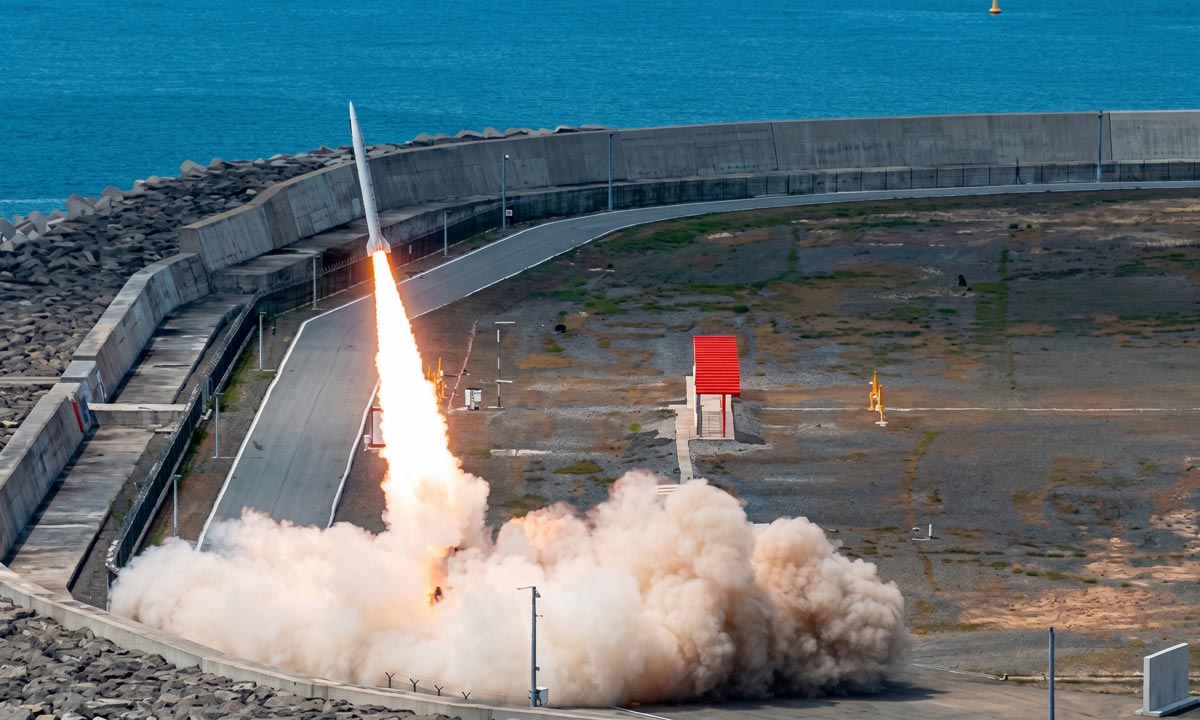
Türkiye’s ROKETSAN has test-fired its TAYFUN Block-3 ballistic missile against a moving target at sea, striking and destroying an unmanned surface vessel in the Black Sea during the missile’s terminal phase. Officials described it as the first publicly announced case of a ballistic missile destroying a free-moving maritime target, a result that puts the TAYFUN Block-3 in the category of anti-ship ballistic missiles, or ASBMs.
The missile, developed domestically by ROKETSAN, detected and hit a surface target whose position kept changing during the terminal phase. That was possible because Block-3 carries a seeker head, the guidance component that lets the missile find and lock onto a target on its own in the final seconds of flight.
Only a small number of countries field this capability. China’s DF-21D is the most established example of an operational ASBM, and the TAYFUN test places Türkiye among the few states able to turn a land-attack ballistic missile into a weapon that can strike ships at sea.
What Turkish officials said
Haluk Görgün, head of the Presidency of Defence Industries (SSB), announced the result in a post on his social media account. He said the domestically developed missile struck a moving target with pinpoint accuracy during a launch that advanced the long-range precision-strike capability of the Block-3 version.
“Our TAYFUN missile will make significant contributions to our security architecture as one of our strategic capabilities that strengthen our country’s deterrence,” Görgün said. He credited the subcontractors, engineers, and technicians on the project, and ROKETSAN in particular.
ROKETSAN General Manager Murat İkinci framed the test as a measure of how far Türkiye has come on seeker integration. “TAYFUN blew very hard again in the Black Sea,” İkinci said. “Our TAYFUN Block-3 missile, which struck a moving target at long range with pinpoint accuracy, once again demonstrated the level our engineering capabilities have reached through seeker integration.”
The test
ROKETSAN fired a missile capable of hypersonic speeds at a free-roaming unmanned surface vehicle standing in for an enemy target. The firing used a live warhead, and the seeker head locked onto the target and destroyed it.
The unmanned surface vehicle was about 7 meters long, representing a small fishing boat. It was struck at very high speed and destroyed.
The seeker is the guidance system at the tip of the missile that detects and locks onto the target on its own. A ballistic missile flies most of its trajectory on inertial navigation (INS) and GPS to reach a pre-set area; in the terminal phase, the seeker takes over, detects the target, and corrects the trajectory to guide the missile in. A conventional ballistic missile lands at the fixed coordinates set at launch and misses if the target has moved. The seeker on Block-3 removes that limit by tracking a target that is still moving during the terminal phase, such as a ship under way.
Because TAYFUN’s cruise speed reaches hypersonic levels, it is harder for air defense systems to intercept, and its accuracy lowers the risk of collateral damage.
Why Block-3 matters
The main advance in Block-3 is not more range but the seeker head and the ability to strike moving surface targets. Block-2, already in service, hits stationary ground targets with high accuracy. Block-3 can find the target at the last moment and adjust its trajectory even if the target has changed position.
The capability is new by international standards. The U.S. Army’s PrSM Increment 2 is also in testing to hit moving ships using a multi-mode seeker.
ROKETSAN said the seeker-equipped missile strengthens strategic deterrence and that it will keep developing the product’s capabilities.