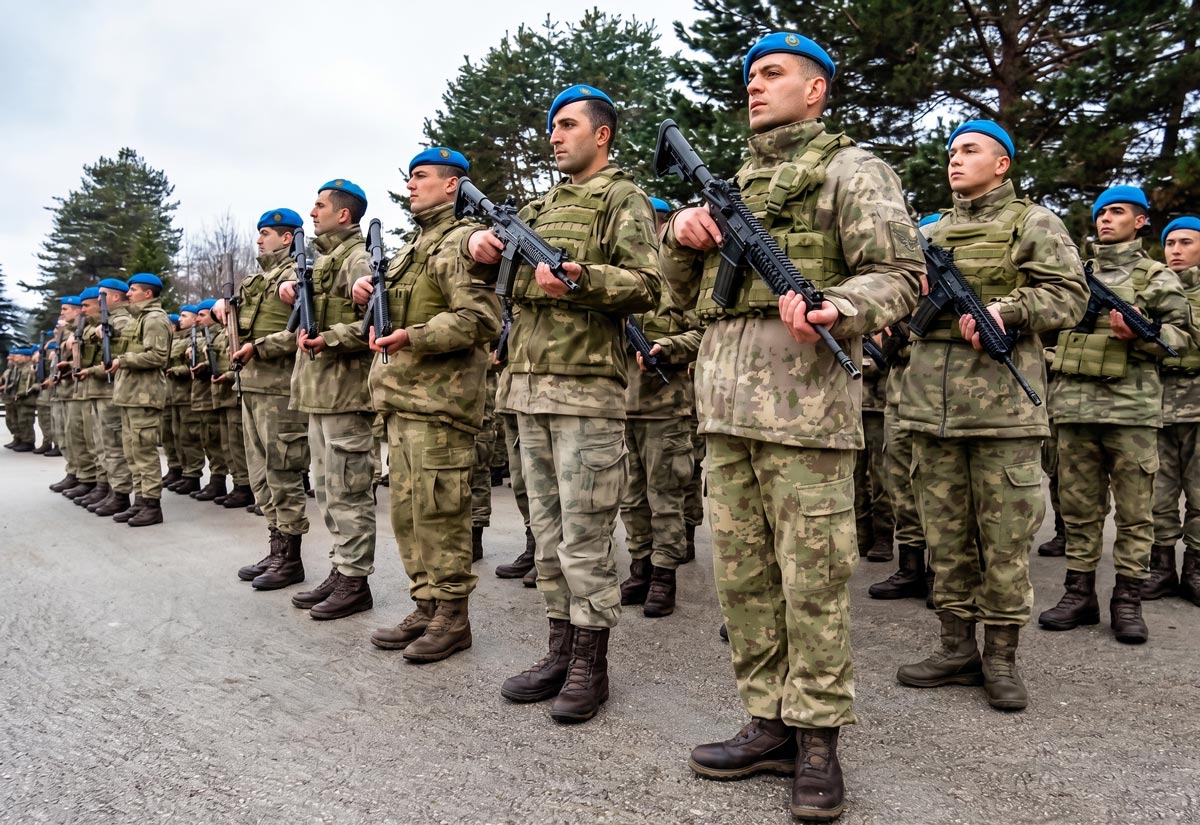
Türkiye’s Ministry of National Defense (MSB) said on Thursday it will establish new commando brigades as part of a broader effort to modernize the Turkish Armed Forces (TSK), drawing on lessons from the Russia-Ukraine war and recent conflicts in the Middle East.
The announcement was made during the ministry’s weekly press briefing at the National Defense University in Ankara, where Rear Admiral Zeki Aktürk said the restructuring aims to align force composition with evolving battlefield conditions and emerging threats.
“Our Ministry closely monitors changes in the nature of warfare and technology,” Aktürk said. “In this context, the Turkish Armed Forces continuously update their organizational structure based on lessons learned following the Russia-Ukraine conflict and the U.S. and Israeli attacks on Iran. Efforts have been initiated to increase the number of commando brigades.”
The ministry said the new brigades would differ from existing formations, adopting a flexible, technology-driven structure tailored to modern operational concepts and current threat assessments.
Shift toward smaller, agile formations
The decision reflects operational lessons from recent conflicts, where smaller, highly mobile units have demonstrated greater effectiveness than large, conventional formations.
MSB officials indicated the new brigades would prioritize rapid deployment, maneuverability and adaptability, in line with contemporary combat requirements observed in Ukraine and across the Middle East.
Integration of UAVs and air defense systems
A key feature of the planned units will be the integration of organic air defense elements and unmanned systems, marking a shift from traditional infantry-centric brigade structures.
The brigades are expected to operate as “hybrid” formations capable of independent missions, supported by UAVs and drone systems to enhance situational awareness, targeting and force protection.
Expanded operational footprint drives demand
Türkiye’s expanding military engagements are also driving the restructuring. Ongoing operations in northern Syria and Iraq have transitioned toward sustained area control, requiring a larger pool of ready and flexible combat units.
At the same time, Ankara’s overseas deployments—from Somalia to Libya—are increasing demand for deployable forces without diluting core domestic capabilities.
“Smart brigade” concept and digitalization
The MSB signaled that the new formations would embody a “smart brigade” concept, emphasizing digitalization and network-centric warfare.
These units are expected to feature integrated communication systems enabling real-time data sharing, as well as enhanced firepower and mobility with reduced personnel. Domestically produced armored vehicles, artillery systems and air defense assets are likely to be embedded within the brigades.
Professionalization and force readiness
Officials said the brigades would largely be staffed by contracted personnel, reinforcing Türkiye’s shift toward a more professional force structure.
Conscripts are expected to be assigned primarily to support roles, while professional soldiers will form the backbone of operational units, improving readiness and combat effectiveness.
Strategic implications
Military analysts say the move represents a significant step in Türkiye’s transition from a Cold War-era force model to a technology-driven, rapidly deployable military designed to boost deterrence.
The new commando brigades are expected to function as semi-autonomous units, integrating artillery, UAV and intelligence capabilities within a single command structure, enabling faster decision-making and operational flexibility.