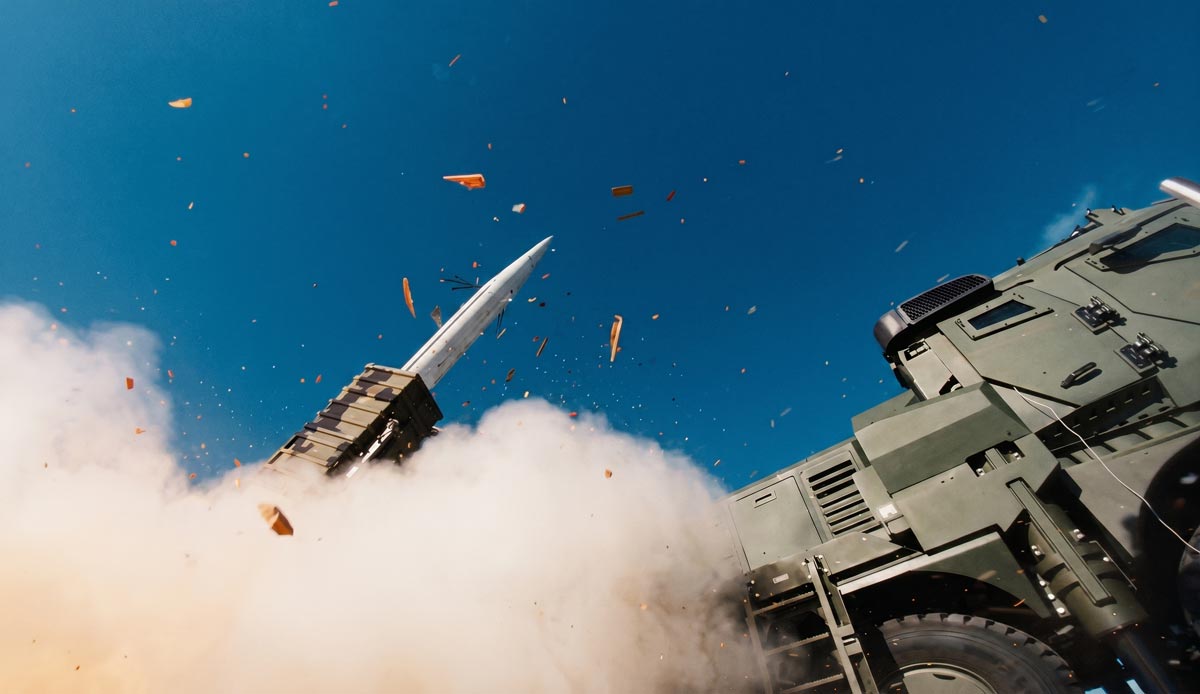
Türkiye’s Ministry of National Defense has officially announced that the domestically developed TAYFUN Block-2 ballistic missile has been inducted into the Türkiye Armed Forces (TSK) inventory for the first time. The milestone was disclosed by Ministry Spokesperson Rear Admiral Zeki Aktürk at a weekly press briefing held during the Efes-2026 Exercise at the Doğanbey Firing Range in İzmir.
Alongside the TAYFUN Block-2, several other domestically produced platforms completed their inspection and acceptance processes under the Land Forces Command and were formally added to the TSK inventory. These include the Akıncı Attack Unmanned Aerial Vehicle (UAV), the Fırtına-2 self-propelled howitzer, and the MPT-76 National Infantry Rifle. Officials described these additions as concrete outcomes of Türkiye’s ongoing defense modernization drive, underpinned by its domestic and national defense industry.
TAYFUN Block-2: Technical Specifications
Developed by ROKETSAN, the TAYFUN Block-2 is a ground-launched ballistic missile system with the following key characteristics:
- Length: 6.5 meters
- Weight: Approximately 2,300 kilograms
- Diameter: 610 millimeters
- Effective range: Over 500 kilometers
- Circular Error Probability (CEP): Approximately 5 meters
The system is equipped with GPS/INS guidance as well as an advanced terminal navigation technology known as GOLIS (Go-Onto-Location-In-Space), which significantly enhances accuracy even in GPS-denied environments — that is, situations where signal jamming or other electronic warfare methods are actively employed.
Strategic Significance: Why TAYFUN Is Hard to Intercept
ROKETSAN General Manager Murat İkinci highlighted the system’s tactical advantage: “While air defense systems are effective against ballistic missiles, their probability of intercepting a target decreases significantly when hypersonic speeds are reached. TAYFUN is therefore a missile that is harder to intercept.”
This resistance to interception, combined with its precision guidance capabilities, positions the TAYFUN Block-2 as a credible long-range strike asset within Türkiye’s integrated defense architecture.
Mobile Architecture and Operational Flexibility
The TAYFUN Block-2 is deployed from ground-based mobile launch vehicles and is designed around the “shoot-and-scoot” principle — a doctrine whereby the launch platform rapidly relocates after firing to reduce vulnerability to counterattack. The system is capable of operating in all weather conditions, day or night, giving it a rapid-response capability against time-sensitive threats.
Looking Ahead: The TAYFUN Block-4 and Türkiye’s Hypersonic Ambitions
The more advanced member of the TAYFUN family, the Block-4, represents a significant leap in capability. Its key parameters include:
- Length: 10 meters
- Weight: Approximately 7.2 tonnes
- Diameter: 938 millimeters
- Speed: Mach 5 and above
- Reported range: Over 1,000 kilometers
This range would theoretically enable Türkiye to strike strategic targets across a geography extending from within its own borders to the Eastern Mediterranean and into Central Europe. Classified as Türkiye’s first hypersonic ballistic missile, the Block-4 represents the next frontier of the country’s indigenous missile program.
Integration into Türkiye’s Broader Defense Architecture
The induction of the TAYFUN Block-2 adds a new layer to Türkiye’s integrated defense strategy, which is built around domestic platforms including the SİPER long-range air defense system, the ÇELİK KUBBE layered missile defense concept, and an expanding fleet of unmanned aerial systems. The combination of long-range precision strike capability and electronic warfare resilience in a single system is already attracting analysis from regional defense observers regarding its implications for the balance of power.
Denizhan Naval Gun and MKE Ammunition Deliveries
In other announcements made at the same briefing, the Machine and Chemical Industry Corporation (MKE) confirmed the delivery of various calibers and quantities of weapons and ammunition during the week. In addition, the seventh unit of the domestically developed Denizhan Naval Gun system successfully completed live-fire acceptance tests and was delivered for integration into the tenth vessel of the MİLGEM (National Ship) Project.