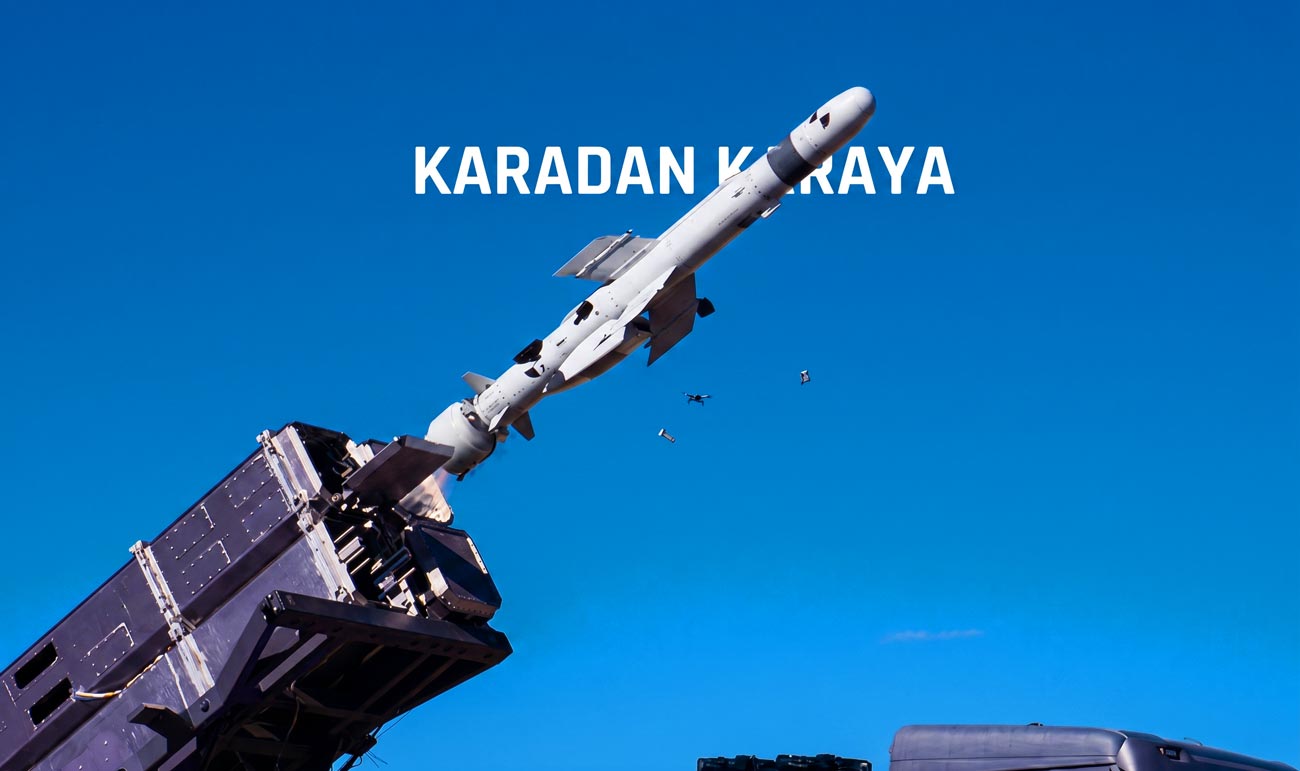
Turkiye’s ROKETSAN said its ÇAKIR cruise missile struck both land and sea targets in two separate firings from a land-based platform, extending the strike capability of a weapon the company is developing for use across land, sea and air platforms.
The tests marked the first time the new-generation missile demonstrated its effectiveness against land targets, adding to the anti-ship capability it had proven in earlier trials. ÇAKIR engaged the targets using a new-generation Imaging Infrared (IIR) seeker head.
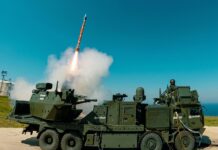
“The ÇAKIR Cruise Missile, successfully fired from a land-based platform, struck both land and sea targets with pinpoint accuracy in two separate firings,” ROKETSAN said in a statement on its social media account. “We remain committed to further advancing our deterrence capabilities across all platforms.”
The ground-vehicle firings also validated the missile’s integration onto various launch platforms. ÇAKIR is capable of being launched from armed unmanned aerial vehicle (UAV) platforms, and the latest tests confirmed its ability to operate from ground vehicles as well.
Extended range and guidance
The trials confirmed an extended range delivered by the missile’s new propulsion system. ÇAKIR draws power from the KTJ-1750 turbojet engine, developed by Kale Arge using domestic capabilities.
Featuring low observability and high strike accuracy, the missile can be deployed against a range of target types in all weather conditions using its inertial navigation and ground-referenced navigation systems. Resistant to countermeasures, it incorporates a retargeting capability along with the ability to update targets and cancel missions via a data link.
A family of variants
ÇAKIR was designed as a broad family of variants built around IIR, radio frequency (RF) and hybrid seeker-head options. The variants include the ÇAKIR CR for ground targets, the ÇAKIR AS for anti-ship missions, the ÇAKIR LIR for electronic warfare and the ÇAKIR SW with swarm capabilities. Its modular design allows integration onto different platforms and engagement of different target types.
The missile is roughly 3 meters long, weighs 275 kilograms and has a range exceeding 150 kilometers. It integrates technologies including an inertial navigation system, swarm capability, artificial intelligence applications and resistance to electronic warfare.
Platform independence
ÇAKIR’s lightweight, compact design gives it broad platform independence, allowing strategic strike capabilities normally confined to large frigates to be carried by small unmanned surface vehicles (SUSVs) such as the ULAQ. The simultaneous export of the ÇAKIR and SUNGUR missiles in January 2025 demonstrated the value of that flexibility in the global market.
The missile’s carriage capacities give operational planners a wide range of options. The Akıncı and Aksungur UAVs and the ULAQ can each carry four ÇAKIR missiles, and fast attack craft can carry eight. Jet-powered aircraft such as the F-16, Hürjet and KAAN, as well as coastal defense systems, can each carry four. In the launch-motor configuration, the S-70B Seahawk and AH-1W Super Cobra helicopters can each carry two.
Coastal defense role
ÇAKIR will also be integrated into coastal defense systems, where it will operate alongside the ATMACA missile — the primary weapon in those systems — to engage smaller targets such as attack boats and unmanned surface vehicles. The missile stands out as a suitable option for small unmanned surface platforms on which the larger ATMACA cannot be mounted.