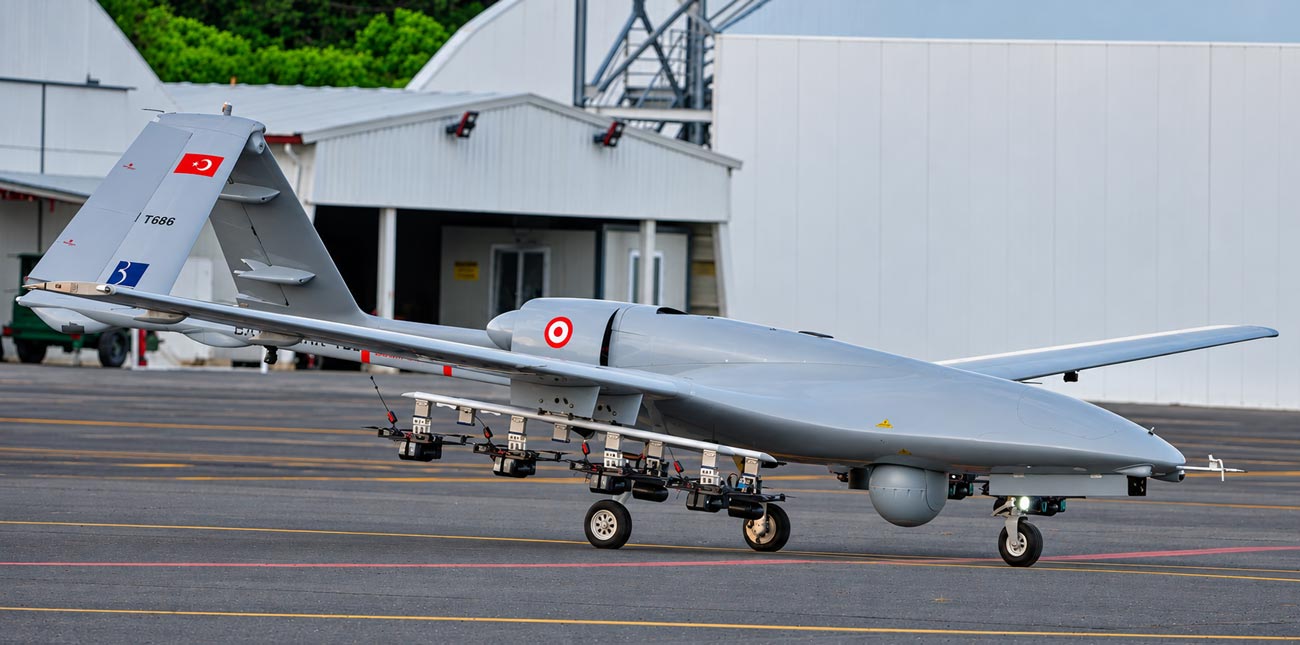
A Bayraktar TB2 armed drone released two Skydagger first-person-view (FPV) kamikaze drones in flight during a test, and both struck their designated targets, manufacturer Baykar said on Wednesday. The company said the footage was the first visual demonstration of the TB2 working as a “mothership” for smaller drones.
Baykar said it had added the capability to the TB2 in response to changing conditions on the battlefield. The FPV drones were built by Skydagger, a company backed by Baykar.
The TB2 took off from the Keşan Flight Training and Test Center carrying 16 Skydagger FPV kamikaze drones and flew to the test area, where two of them separated from the aircraft, Baykar said.
Separate operators on the ground flew the released drones over a link relayed through the TB2. Footage released by the company showed the drones closing on their targets and the moment of impact.
Skydagger’s FPV family and earlier air launches
Skydagger began producing FPV kamikaze drones in 2024 with Baykar’s support. Its range has three sizes:
- 7-inch model: 2-kilogram payload
- 10-inch model: 3-kilogram payload
- 15-inch model: 5-kilogram payload
Baykar General Manager Haluk Bayraktar has said the production line reached an annual capacity of 120,000 drones.
The TB2 test builds on Baykar’s work with smaller platforms. On Nov. 29, 2025, the company released a Skydagger 7 FPV drone during a flight of the Bayraktar KALKAN vertical takeoff and landing (VTOL) unmanned aerial vehicle (UAV). Skydagger General Manager Mehmet Öztekin said the company was working to integrate small drones on several Baykar platforms.
Using the TB2 as an FPV carrier is not a new idea for Baykar. At SAHA EXPO in October 2024, the company signed an agreement with Croatian FPV maker Orqa to integrate its drones on the TB2.
Skydagger drones are already in service. Kosovo ordered thousands of them in 2024, and they were delivered ahead of schedule in October 2025, entering service alongside the country’s TB2 and Puma UAVs.
Drone motherships in Ukraine, Russia, the U.S. and China
Launching small drones from a larger UAV has spread quickly during the war in Ukraine. Ukraine’s domestically produced Dovbush T10 has been adapted to carry and release FPV kamikaze drones. Separately, Mykhailo Fedorov, then Ukraine’s digital transformation minister, said in May 2025 that a carrier system developed within the Brave1 defense technology cluster could deliver two AI-guided FPV drones up to 300 kilometers behind enemy lines.
Russia has taken a similar path. Its Molniya platform carries FPV attack drones dozens of kilometers behind Ukrainian lines, and the Pchelka used by Russian forces can also deploy FPV drones while acting as a signal relay.
The U.S. is working in the field through its air-launched effects (ALE) program. General Atomics Aeronautical Systems’ (GA-ASI) Eaglet made its first flight on Dec. 8, 2022, after being released from a U.S. Army MQ-1C Gray Eagle Extended Range. The ALTIUS-600 has been launched from UH-60 Black Hawk helicopters and, since 2020, from the Gray Eagle.
China is building on a larger scale. The jet-powered Jiutian, with a reported maximum takeoff weight of about 16 metric tons, made its maiden flight on Dec. 11, 2025. Aviation Industry Corporation of China (AVIC) has said swarm drone launch is a central feature of the aircraft, and Chinese sources say it can deploy about 100 small drones.
Range, jamming resistance and cost
Short range is the main limitation of FPV drones. The TB2 is a medium-altitude, long-endurance (MALE) aircraft with reconnaissance sensors, so carrying FPV drones extends their reach out to the carrier’s own combat radius.
The arrangement may also help against electronic warfare. According to Russian sources, a carrier that acts as a relay and flies close to the FPV drone makes jamming much less effective. Baykar’s use of the TB2 as a link node in the test follows the same logic.
The pairing also shortens the time between spotting a target and hitting it. The TB2 finds and tracks the target with its electro-optical sensor, and the FPV drone delivers the final strike. Operators can spend a cheap effector instead of a costly guided munition, which gives them more flexibility against moving and dispersed targets.
Carrying several drones on one flight also opens the way to swarm tactics. The TB2 remains vulnerable to advanced air defense systems, however, so the concept fits low- and medium-intensity threat environments best.