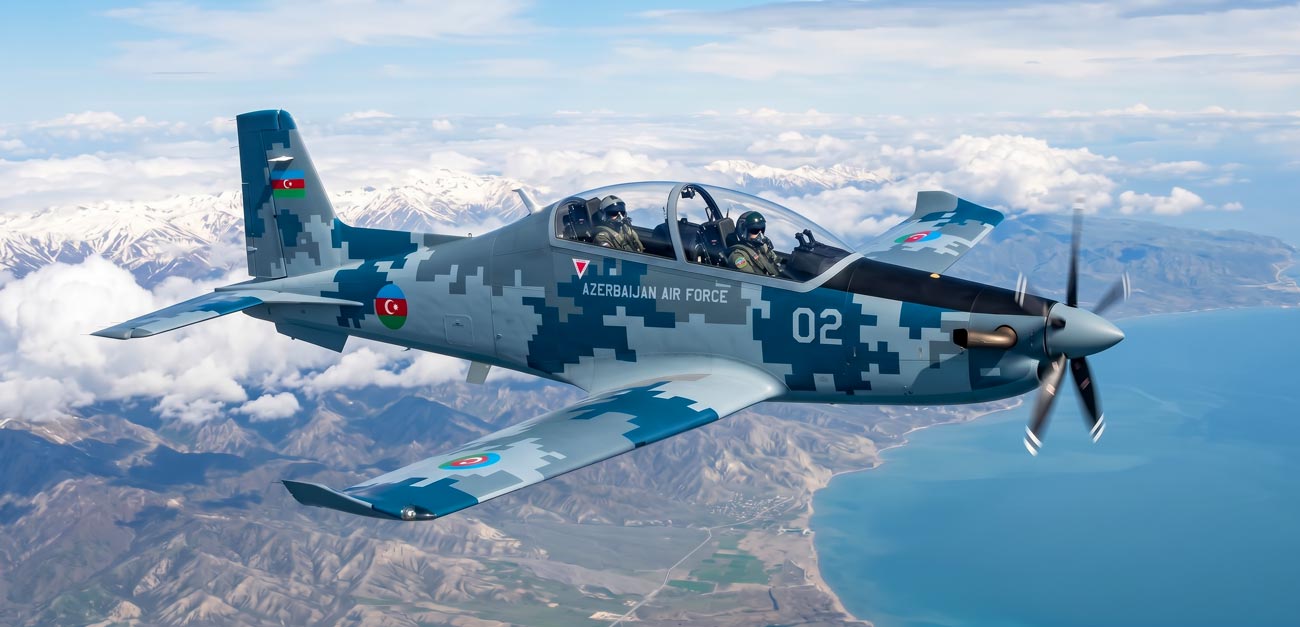
Türkiye has signed its first export contract for the HÜRKUŞ-II basic trainer aircraft, selling 14 of the Turkish Aerospace Industries (TUSAŞ) planes to Azerbaijan, with first deliveries due this year, the head of Türkiye’s defense procurement agency said at the Azerbaijan International Defense Exhibition (ADEX 2026) in Baku.
“Today, we signed the first export contract for these aircraft with our brother nation, Azerbaijan,” said Haluk Görgün, president of the Presidency of Defense Industries (SSB). “God willing, we will make the first deliveries to Azerbaijan this year just as quickly as we will to our own Air Force.”
The contract was signed two days after the first two HÜRKUŞ-II aircraft were delivered to the Turkish Air Force Command on Sept. 28. It was part of a package of five agreements signed at the exhibition with a combined value of more than $500 million.
Serial production under way
Görgün said serial production of the HÜRKUŞ-II had begun, with 55 aircraft to be built for Türkiye and 14 for Azerbaijan.
“We plan to produce between 12 and 14 aircraft in 2026, and we will deliver some of these to Azerbaijan,” he said, adding that the production rate was planned to meet the needs of both customers at the same time.
The program passed several milestones in September:
- Sept. 9: military type certification completed
- Sept. 15: final test flights, in which Görgün took part alongside the Air Force commander
- Sept. 28: first two aircraft delivered to the Air Force Command
Two aircraft for Azerbaijan by year-end
TUSAŞ General Manager Mehmet Demiroğlu said preparations to deliver two aircraft to Azerbaijan by the end of the year were complete, and that the aircraft would be handed over once Azerbaijani pilots finished their training.
Deliveries to the Turkish Air Force will continue through the end of the year and in the years that follow. Demiroğlu said a total of 70 HÜRKUŞ-II aircraft would be produced under the two programs.
Joint pilot training
Demiroğlu said the HÜRKUŞ-II would serve as a common training platform for the two countries’ air forces, a plan he said had been in place from the start, with the contract as its first step.
“Just as Turkish Air Force pilots receive training today, Azerbaijani Air Force pilots will also be able to receive the same training, and pilot exchanges will be possible,” he said. Because both countries will operate the same system, Azerbaijani pilots will be able to train in Türkiye when needed, he added.
Armed version on the agenda
Demiroğlu described the 14 aircraft for Azerbaijan as a “provisional” number and said TUSAŞ expected the number of training aircraft to rise in the coming years.
The HÜRKUŞ comes in two configurations, basic training and light armed attack. TUSAŞ plans to deliver the armed configuration to the Turkish Air Force, the Azerbaijani Air Force and friendly and allied countries, he said.
TUSAŞ has previously exported the first version of the HÜRKUŞ to several countries. Demiroğlu said foreign customers typically wait for a platform to enter the manufacturer’s own national inventory before buying it.
“We have now moved past that stage. We have also moved past the export stage,” he said, predicting export opportunities for the aircraft in various regions.
Five agreements worth more than $500 million
The package signed at ADEX 2026 comprised:
- a HÜRKUŞ supply contract with TUSAŞ
- a memorandum of understanding with ASELSAN on the supply of ALP-100 radars
- two Baykar supply contracts, for the MIZRAK smart loitering munition and the Antidot
- a ROKETSAN supply contract for the Barbaros coastal defense system
ROKETSAN was one of the exhibition’s main sponsors.
Görgün said Azerbaijani officials had told him that Azerbaijan signed procurement contracts at the exhibition only with Türkiye and made no supply agreements with any other country. He called this “an honor” for the Turkish side.
Local production and technology transfer
Görgün said cooperation went beyond the sale of systems. “Investments are being made to support local production, joint ventures are being established, and technology transfer is taking place,” he said.
About 300 people work at Baykar’s facility in Azerbaijan. The Kasırga, developed by Baykar’s Azerbaijani research and development staff and manufactured in the country, was shown for the first time at the exhibition, where Azerbaijani President Ilham Aliyev was briefed on it during a visit to the stand.
A company set up in Azerbaijan in partnership with ROKETSAN has begun producing 122 mm artillery rockets in its first phase. It also operates assembly and production infrastructure for tactical missiles including the TRLG-230 and TRG-300, the TEBER and LAÇİN guidance kits, and the MAM series of smart munitions.
Görgün said a turnkey plant for rounds and munitions had also been built and would be handed over to Azerbaijani management together with the associated technical know-how.
Research and workforce protocol
Before the supply contracts, the two sides signed a four-party framework protocol covering defense industry research, development and workforce training. The signatories are Azerbaijan’s Ministry of Education and Ministry of Defense Industry, and Türkiye’s Council of Higher Education (YÖK) and the SSB. Under the protocol, universities and research institutions in the two countries will pool resources toward shared competency goals.
Turkic states procurement meeting
Görgün said a technology meeting would be held during the exhibition with the defense procurement authorities of Organization of Turkic States members, attended by Azerbaijan, Kazakhstan and Uzbekistan, to discuss existing production capabilities and procurement capacity.
“We are aware that we must be strong to establish peace in the world,” he said.
The three-day ADEX 2026, the exhibition’s sixth edition, has drawn more than 270 companies from 46 countries. Türkiye is represented by 61 companies and has the largest national pavilion.