Turkiye has significantly expanded its defence production capacity following the inauguration of new facilities by ROKETSAN in Lalahan, Ankara, as part of efforts to strengthen military self-reliance and reduce foreign dependency.
Speaking at the opening and delivery ceremony, President Recep Tayyip Erdoğan said the investments would enhance Turkiye’s defence infrastructure, particularly in air defence and missile technologies.
“With these new facilities, we are strengthening our military capabilities,” Erdoğan said, adding that increased production would reinforce the country’s air defence architecture.
He emphasized that Turkiye has made significant progress in reducing external dependency in defence procurement. “Today, we are a country capable of protecting its own skies, equipping its platforms and producing its own weapons with domestic resources,” he said.
The government aims to reach $11 billion in defence exports by 2028, a target that could place Turkiye among the world’s top 10 arms exporters.
Critical facilities boost missile component production
Two key facilities stand out in the new investment package:
- Kırıkkale Fuel Production Facility: Focused on localising rocket and missile propulsion systems.
- Lalahan Warhead Production Facility: Designed to increase domestic warhead production capacity.
These facilities address two of the most critical missile components—propulsion systems and warheads—significantly reducing reliance on foreign suppliers.
Advanced R&D centre targets next-generation warfare
ROKETSAN also launched an Advanced Technologies R&D and Engineering Center to develop next-generation defence systems.
The centre will focus on:
- High-speed missile technologies
- Laser-based weapon systems
- AI-enabled and swarm-capable munitions
The initiative aims to consolidate Turkiye’s engineering and research capabilities under a single structure.
Wide range of indigenous systems delivered
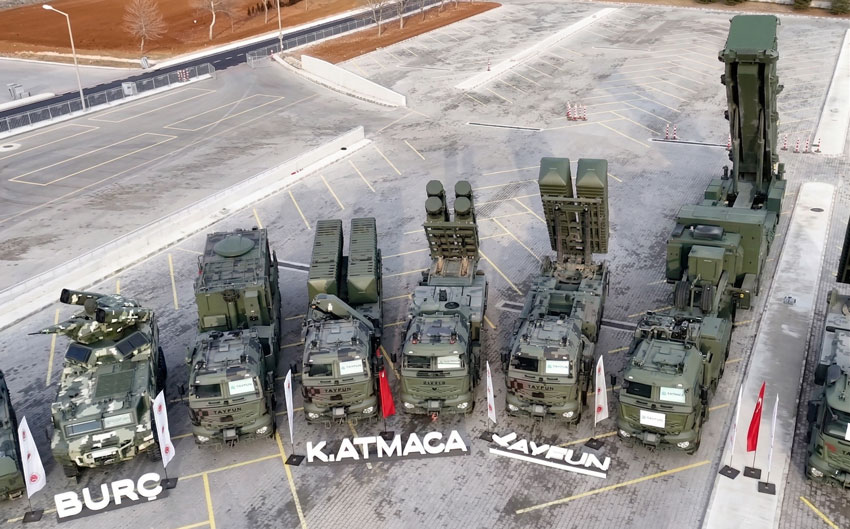
During the ceremony, multiple domestically developed systems were delivered to the Turkish Armed Forces, including:
- TAYFUN ballistic missile
- SİPER long-range air and missile defence system
- ATMACA anti-ship missile
- HİSAR-A and HİSAR-O air defence systems
- SUNGUR air defence system
- SOM, ÇAKIR and KARA ATMACA cruise missiles
- MAM-L, MAM-C and MAM-T smart munitions
- L-OMTAS, OMTAS, LUMTAS and KARAOK anti-tank systems
- İHA-230 supersonic air-to-ground missile
Production capacity increases fivefold
ROKETSAN said it has reinvested a significant portion of its revenues into infrastructure and production capabilities, increasing output capacity fivefold.
New production lines, integrated with the supply chain, will boost output in:
- Tactical and strategic missile systems
- Air defence interceptors
- Naval strike missiles
Officials noted that the expansion enhances both production volume and product diversity across offensive and defensive systems.
Strategic impact: greater autonomy in defence production
The new facilities are expected to strengthen Turkiye’s ability to produce critical missile components domestically, ensuring supply continuity and long-term strategic planning.
By localising key technologies such as rocket motors and warheads, Turkiye aims to enhance defence independence and reduce vulnerability to external supply constraints.