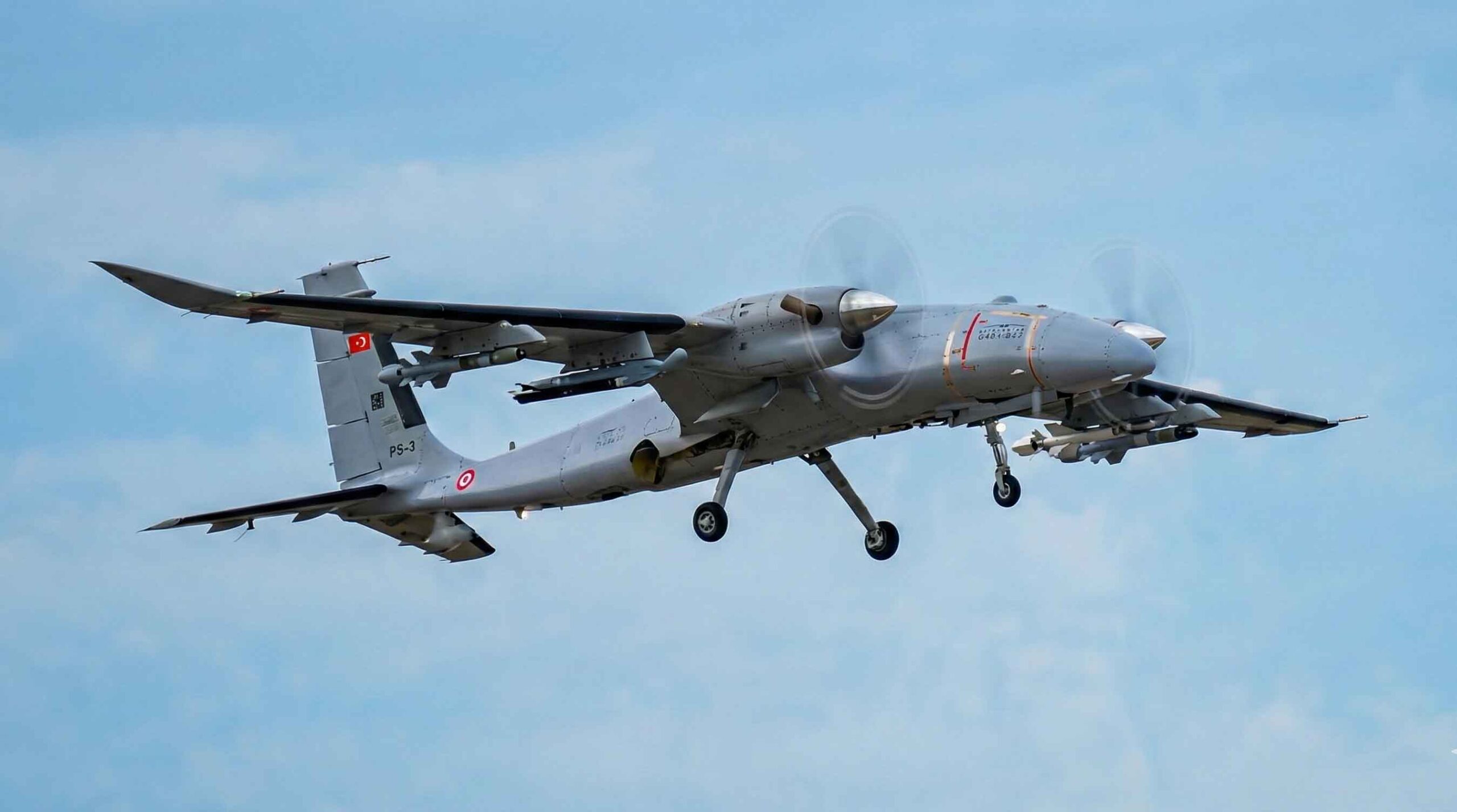
A new generation high-speed loitering munition developed by ROKETSAN was successfully fired from the Baykar-produced Bayraktar AKINCI unmanned combat aerial vehicle (UCAV), validating the system’s air-to-air and air-to-ground engagement capabilities.
The test demonstrated EREN’s ability to detect, track, and engage both airborne and ground targets under operational conditions.
AESA-Supported, High-Speed Loitering Munition
EREN offers long-range reconnaissance and strike capability with a stated range exceeding 100 kilometers and an airborne endurance of more than 15 minutes. Powered by a turbojet engine, the munition reaches significantly higher speeds than conventional propeller-driven loitering munitions.
Its AI-assisted electro-optical seeker enables precision engagement against low-speed aerial targets, armored and unarmored ground vehicles, and personnel. Integrated AESA radar enhances target detection and tracking, particularly in complex and contested environments.
Multi-Platform Launch Architecture
With a length of approximately 2 meters, a weight of 35 kilograms, and a 160 mm diameter, EREN is designed for deployment from a wide range of platforms, including:
- UAVs and UCAVs
- Helicopters
- Ground vehicles
- Naval platforms
- Ground-based launch systems
This multi-platform design positions EREN not only as an offensive strike asset but also as a complementary element for short-range air defense.
Ground-to-Air Concept and Containerized Launch System
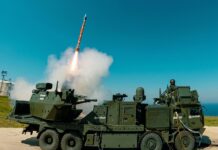
Development of EREN’s ground-to-air operational concept accelerated in 2025. At IDEF 2025, ROKETSAN unveiled a Containerized EREN Launch Vehicle mounted on a 6×6 tactical wheeled platform and visually disguised as a civilian cargo container.
The system includes:
- 12 sealed launch tubes integrated inside the container
- Four AESA radar antennas, each providing 90-degree coverage, mounted on an elevating mast
- Data-link antennas
- An integrated command-and-control module
Through a two-way, encrypted data link, operators can monitor EREN in real time and update targets during flight. The low-signature, mobile, containerized design supports distributed and survivable combat concepts by reducing detection and targeting risk.
Engine Selection and Production Planning
During the prototype phase, EREN was powered by a foreign-sourced, low-cost turbojet engine due to the high unit cost of domestic alternatives. For series production, ROKETSAN is evaluating the TEI-TJ90 micro turbojet engine.
The TJ90 variant offers FADEC support, reduced weight, and a smaller diameter—key parameters for cost-effective loitering munition production, where unit price remains a decisive factor.
Operational Capabilities and Data Link
The stated 100+ km range includes both transit distance and time spent loitering while tracking the target. EREN communicates via a two-way, encrypted RF data link within line-of-sight (LoS), enabling integration with platforms such as AKINCI, TB2, ANKA, and AKSUNGUR.
For air targets, EREN employs a proximity-triggered fragmentation warhead. Alternative warhead configurations are available depending on mission requirements, and the munition includes a self-destruct function.
Test Campaign and Timeline
In an initial firing conducted ahead of IDEF 2025, EREN successfully struck a ground target. The program is aiming to transition to mass production in 2026.
In a test video released by Baykar on August 7, 2025, EREN is shown igniting its turbojet engine under the wing of the AKINCI before launch, accelerating rapidly, and proceeding toward a maritime target. The footage also highlights the RF data-link pod enabling two-way communication.